
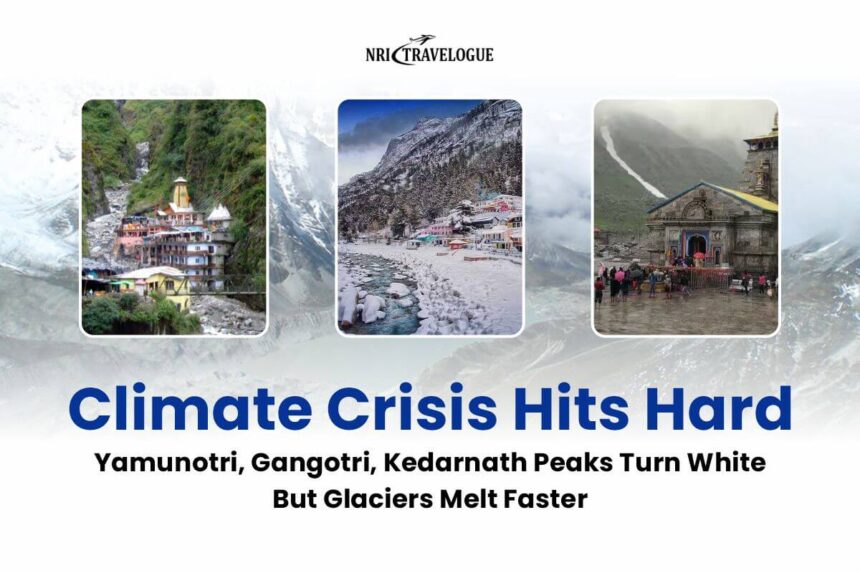
At first glance, the snow-covered peaks of Yamunotri, Gangotri, and Kedarnath look reassuring. Fresh white layers often signal healthy winters and stable glaciers. But experts say this picture is misleading. While snowfall has increased in short bursts, glaciers in the central Himalayas are shrinking faster than ever. This contrast highlights how severe the climate crisis has become in Uttarakhand. This article explains why these peaks are turning white while glaciers continue to melt, what it means for rivers and communities, and why urgent climate action matters now more than ever.
The Illusion of Heavy Snowfall in the High Himalayas
Recent winters have brought intense snowfall to parts of Uttarakhand. Yamunotri and Gangotri, the sources of the Yamuna and Ganga rivers, have seen repeated snow events that made headlines. Kedarnath’s peaks have also remained snow-clad longer than usual.
However, scientists point out that snowfall alone does not equal glacier health. Short, heavy snow spells are often linked to erratic weather patterns driven by climate change. These events are followed by warmer summers that cause rapid ice loss. As a result, glaciers gain temporary surface snow but lose more ice overall.
This pattern is now common across the Himalayas and is a clear sign of climate change impact in mountain regions.
Why Glaciers Are Melting Faster Despite Cold Winters
Glaciers respond to long-term temperature trends, not just seasonal snowfall. Rising average temperatures mean that melt seasons start earlier and last longer. Even when winters bring snow, warmer air and heat waves during spring and summer undo any gains.
In the Gangotri glacier region, studies show consistent ice thinning over the past two decades. The Yamunotri glacier has also retreated significantly, reducing its ability to regulate river flow. Kedarnath’s surrounding glaciers face similar stress, increasing the risk of glacial lake outburst floods.
This accelerated glacier melting threatens water security for millions downstream and increases the frequency of disasters. It is one of the most visible signs of the climate crisis in India.
Impact on Rivers, Pilgrimage Routes, and Local Livelihoods
The Himalayas act as India’s water tower. When glaciers shrink, river systems become unstable. Initially, faster melting causes floods. Over time, reduced ice reserves lead to water shortages during dry seasons.
Pilgrimage towns like Kedarnath, Gangotri, and Yamunotri are especially vulnerable. Roads, bridges, and settlements are often built along fragile slopes. Extreme weather events damage infrastructure and disrupt tourism, a key income source for local communities.
Sustainable tourism Uttarakhand initiatives are now being discussed to balance economic needs with environmental protection. Without such measures, both livelihoods and sacred sites remain at risk.
The Role of Climate Change Impact and Human Activity
The climate crisis is not acting alone. Deforestation, unplanned construction, and rising tourist footfall amplify natural risks. Black carbon from vehicles and biomass burning settles on snow, reducing its reflectivity and speeding up melting.
Addressing climate change impact requires both global emission cuts and local action. Environmental conservation services, including glacier monitoring, afforestation, and disaster planning, play a crucial role in protecting these sensitive regions. Investing in such solutions can slow damage and help communities adapt.
Conclusion: Time to Act Before the Ice Is Gone
The white peaks of Yamunotri, Gangotri, and Kedarnath may look calm, but they hide a serious warning. Glaciers are melting faster despite heavier snowfall, showing how unpredictable and dangerous the climate crisis has become. Protecting these mountains is not just about preserving beauty or faith. It is about safeguarding water, lives, and future generations.
Governments, businesses, and individuals must support climate-resilient development, responsible travel, and environmental conservation services. The Himalayas cannot wait. Every step taken today can help slow glacier melting and secure a more stable tomorrow.