


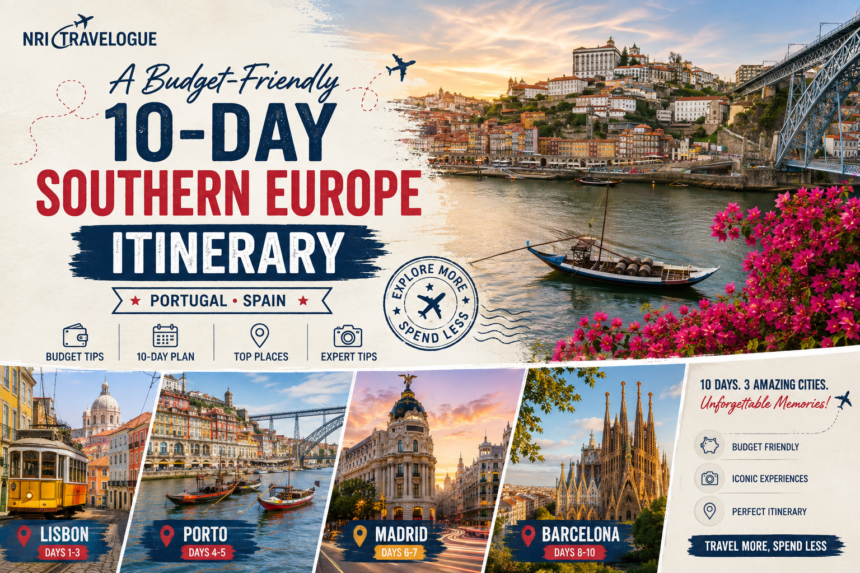
Southern Europe is one of those parts of the world where it is very easy to plan too much. Historic cities sit only a few hours apart, low-cost flights make another country look tempting, and suddenly a relaxing holiday becomes a race between airports and railway stations.
But ten days is enough to experience several different sides of Southern Europe without spending the whole trip in transit.
This itinerary takes you from Lisbon to Porto, then across to Madrid and Barcelona. You get two countries, four very different cities, Atlantic viewpoints, Portuguese food, Spanish art, lively neighbourhoods and Mediterranean evenings. More importantly, the route can be done without renting a car.
If you book accommodation and intercity transport early, it is also possible to keep the trip reasonably affordable.
10-Day Southern Europe Itinerary at a Glance
- Day 1: Arrive in Lisbon and explore Baixa
- Day 2: Alfama, viewpoints and historic Lisbon
- Day 3: Belém and the Tagus waterfront
- Day 4: Travel to Porto and explore Ribeira
- Day 5: Porto, Gaia and the Douro
- Day 6: Travel to Madrid and explore the historic centre
- Day 7: Madrid museums, Retiro Park and tapas
- Day 8: Train to Barcelona and explore the Gothic Quarter
- Day 9: Gaudí, Gràcia and Barcelona viewpoints
- Day 10: Beach, Montjuïc and departure
The easiest way to organise the trip is to fly into Lisbon and home from Barcelona. This avoids returning to your starting point and saves both time and money.
Day 1: Arrive in Lisbon and Explore Baixa
Lisbon is an excellent place to begin a Southern European trip because you do not need a car to enjoy the city.
After arriving, leave your luggage at your accommodation and keep the first day simple. Start around Praça do Comércio, the large square facing the Tagus River. From here, walk through the streets of Baixa towards Rossio Square.
This part of Lisbon is relatively flat, which is useful after a flight. You can explore shops, cafés and tiled façades without tackling the city’s famous hills immediately.
Later in the afternoon, walk towards Chiado and stop at one of the viewpoints above the centre. For dinner, avoid choosing a restaurant directly beside the busiest attractions. Walking only a few streets away from the main squares can make a noticeable difference to the price.
Budget Tip: Lisbon has plenty of bakeries and casual restaurants where you can eat well without booking a formal restaurant for every meal.
Estimated daily cost: €60–€100 per person including simple accommodation, food and local transport.
Day 2: Alfama, Castelo and Lisbon’s Viewpoints
Your second day is for Lisbon’s oldest neighbourhoods.
Start early in Alfama, before the narrow streets become busy. The area is full of staircases, tiled houses, small squares and viewpoints overlooking the river.

One of the easiest ways to explore Lisbon without exhausting yourself is to travel uphill first and gradually walk back down. Visit Miradouro das Portas do Sol or Miradouro de Santa Luzia before continuing through Alfama.
You can also visit São Jorge Castle if it fits your budget. If not, Lisbon has enough free viewpoints that you can still enjoy spectacular panoramas without paying for every attraction.
Continue downhill towards Lisbon Cathedral and eventually return to Baixa. In the evening, explore Bairro Alto or return to Alfama for dinner.
You may be tempted to use Lisbon’s historic trams for every journey, but they are not always the fastest option. Walking downhill and using the metro or buses for longer journeys can be both easier and cheaper.
Day 3: Belém and the Tagus Waterfront
Dedicate the third day to Belém rather than trying to combine it with central Lisbon.
Start with the Jerónimos Monastery area before walking towards the river. The Monument to the Discoveries and Belém Tower are both located along the waterfront, making this a very easy area to explore on foot.
You should also stop for a pastel de nata. Belém is closely associated with the famous Portuguese custard tart, although you will find excellent versions throughout Lisbon.
If you enjoy museums, choose one rather than attempting to visit everything. The MAAT is a good option for contemporary art and architecture, while the National Coach Museum offers something completely different.
Spend your final Lisbon evening somewhere relaxed around Chiado, Cais do Sodré or the riverfront.
Pro Tip: Do not squeeze Sintra into these three days. It deserves most of a day by itself. If Sintra is essential, add an eleventh day to this itinerary.
Day 4: Travel from Lisbon to Porto
Leave Lisbon in the morning and travel north to Porto.
Train and coach services connect the two cities, so there is little reason to fly. Booking ahead usually gives you more choice and better prices.
Once you arrive, check in and spend the afternoon exploring the historic centre. Start around São Bento Station, famous for its blue-and-white tile panels, before walking downhill towards Porto Cathedral and the Ribeira district.
Ribeira is Porto’s most recognisable neighbourhood. Colourful houses climb above the Douro River, cafés fill the waterfront and the Dom Luís I Bridge connects Porto with Vila Nova de Gaia.

Cross the bridge before sunset if the weather is clear.
One of Porto’s strengths for a budget traveller is that much of the experience comes simply from walking through the city. The streets, bridges and viewpoints are the main attraction.
Estimated daily cost: €55–€90 per person plus your Lisbon-Porto ticket.
Day 5: Porto, Gaia and the Douro
Begin the morning around Bolhão Market, then walk through Porto’s central streets towards Clérigos.
From here, you can explore Cedofeita or slowly return towards the river. The afternoon is a good time to cross into Vila Nova de Gaia, home to Porto’s famous port wine cellars.
You do not need to visit several cellars. One well-chosen tour or tasting is enough to understand how port wine is produced and aged.
If you prefer to keep the day inexpensive, simply walk along the Gaia waterfront before climbing towards Jardim do Morro for views back across Porto.
Porto is quite hilly, so choosing accommodation close to the centre can save more money than booking a cheaper room far outside the city and repeatedly paying for transport.
If you have extra time or want to extend this itinerary, this practical Porto itinerary gives a more detailed three-day route through the city without a car.
Day 6: Fly to Madrid and Explore the Historic Centre
This is the only part of the itinerary where flying can make more sense than travelling overland.
Portugal and Spain look very close on a map, but rail connections between Porto and Madrid are not as simple as the Lisbon-Porto or Madrid-Barcelona journeys. A short flight therefore saves a significant amount of travel time.
Try to choose a morning departure so that you still have most of the afternoon in Madrid.
Once you arrive, start around Puerta del Sol and walk towards Plaza Mayor. Continue towards the Royal Palace and Almudena Cathedral before exploring La Latina in the evening.
Madrid is a city that works particularly well on foot. The historic centre is compact enough to explore without constantly using public transport.
For dinner, try several smaller dishes rather than choosing an expensive restaurant directly around Plaza Mayor.
Budget Tip: If you are flying with a low-cost airline, check the baggage rules carefully. A cheap ticket can stop being cheap once cabin and checked luggage fees are added.
Estimated daily cost: €65–€105 per person plus the flight from Porto.
Day 7: Madrid Museums, Retiro Park and Tapas
Madrid deserves at least one complete day.
If you enjoy art, begin around the Prado Museum. You could easily spend several hours inside, so there is little reason to combine several major museums unless art is the main purpose of your trip.
Afterwards, walk through Retiro Park. It is one of Madrid’s best free attractions and provides a welcome break from museums and busy streets.
Later, explore neighbourhoods such as Malasaña, Chueca or La Latina.
Madrid becomes especially enjoyable in the evening when people fill terraces and small restaurants. Instead of looking for a single “best tapas restaurant”, try a few different places and order one or two dishes at each.
This is also a useful strategy for controlling your food budget.
Day 8: High-Speed Train to Barcelona
Take a morning train from Madrid to Barcelona.
This is one of the easiest transfers of the trip because the two city centres are connected by high-speed rail.
After arriving in Barcelona, leave your luggage and begin with the Gothic Quarter. Walk around Barcelona Cathedral, Plaça Reial and the narrow streets leading towards the waterfront.
From there, continue into El Born, one of the most enjoyable neighbourhoods for cafés, small shops and evening walks. You can also visit Santa Maria del Mar before continuing towards Parc de la Ciutadella.
Barcelona is generally more expensive than the previous cities on this itinerary, particularly for accommodation. Staying slightly outside the Gothic Quarter but close to a metro station can therefore offer better value.
Estimated daily cost: €70–€120 per person plus your Madrid-Barcelona train ticket.
Day 9: Gaudí, Gràcia and Barcelona From Above
Your ninth day is the one to dedicate to Barcelona’s most famous architecture.
Start early at the Sagrada Família. If you want to visit the interior, book your ticket before arriving in Barcelona. It is one attraction where simply turning up and hoping for a convenient entry time is not a reliable plan.
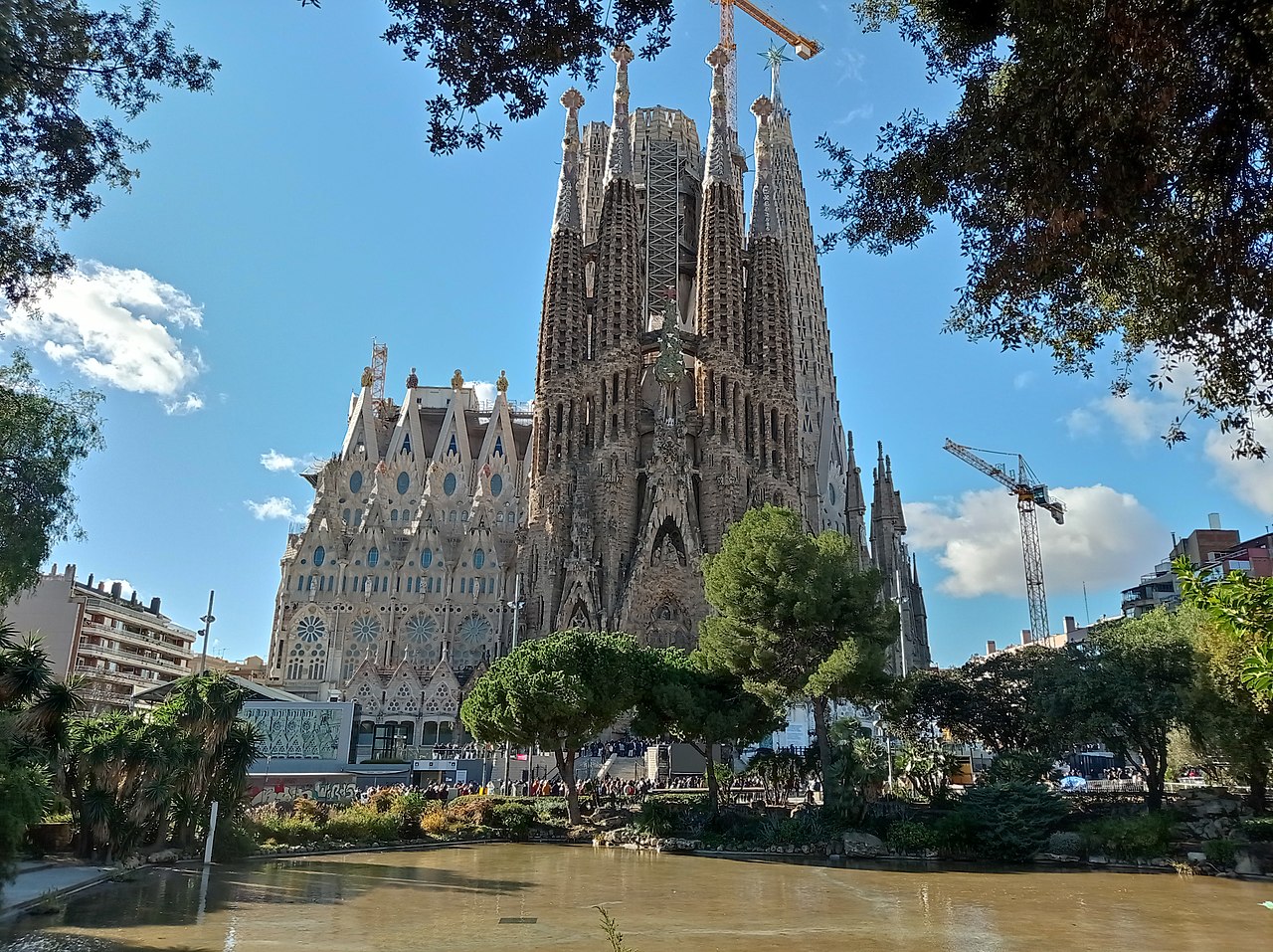
Continue towards the Gràcia neighbourhood after your visit. Gràcia feels very different from central Barcelona, with smaller squares, neighbourhood cafés and streets that are enjoyable without a sightseeing checklist.
Later, visit Park Güell or choose one of Barcelona’s free viewpoints.
You do not need to pay for every Gaudí building. Seeing one major interior properly and enjoying the rest from outside is a perfectly reasonable strategy on a budget trip.
Finish the evening with dinner in Gràcia or return towards El Born.
Day 10: Montjuïc, the Mediterranean and Departure
Keep your final day flexible, especially if you have an evening flight.
If the weather is good, spend some time along the Mediterranean waterfront. You can walk around Barceloneta before continuing towards the port.
Alternatively, head to Montjuïc, where gardens and viewpoints provide another side of Barcelona.
This is a better final morning than trying to squeeze another major attraction into the itinerary before going to the airport.
After nine busy days, leave yourself enough time for a slow lunch and one last walk. Then collect your luggage and travel to the airport.
How Much Does a 10-Day Southern Europe Trip Cost?
Southern Europe is not as cheap as it once was, especially in Lisbon and Barcelona. But travelling between only four cities helps keep costs under control.
For a budget-conscious traveller, a reasonable planning range is:
| Expense | Estimated Cost Per Person |
|---|---|
| 9 nights accommodation | €300–€500 |
| Food | €220–€320 |
| Intercity transport | €90–€180 |
| Local transport | €50–€80 |
| Attractions | €80–€160 |
| Estimated total | €740–€1,240 |
This estimate excludes your flights to and from Europe.
The lower end assumes hostels or inexpensive rooms, advance transport bookings and plenty of free attractions. A traveller choosing private central hotels, last-minute trains and several major paid attractions should expect to spend more.
For couples, sharing a double room can sometimes bring the accommodation cost per person close to hostel prices in expensive cities.
How to Keep This Southern Europe Itinerary Affordable
Book an Open-Jaw Flight
Search for a flight arriving in Lisbon and departing from Barcelona. Returning to Lisbon simply to catch your flight home wastes both time and money.
Travel With Less Luggage
A smaller bag makes trains easier and can dramatically reduce the price of the Porto-Madrid flight.
Stay Near Public Transport
Do not automatically choose the cheapest accommodation. Saving €10 on a room far from the centre is not worthwhile if you then spend money and time travelling back and forth every day.
Choose Your Paid Attractions
Lisbon’s viewpoints, Porto’s riverfront, Madrid’s neighbourhoods and Barcelona’s beaches provide plenty to see for free. Choose the attractions that genuinely interest you instead of purchasing a ticket for everything.
Book Intercity Transport Early
This matters especially for the Madrid-Barcelona train and the Porto-Madrid flight. Flexible travellers can often save money by comparing morning, afternoon and evening departures rather than insisting on one specific time.
Best Time for This 10-Day Southern Europe Itinerary
April to June and September to October are usually the most comfortable periods for this route.
You can expect pleasant walking weather and generally avoid the strongest summer heat. July and August are possible, but accommodation is usually more expensive and Madrid in particular can become extremely hot.
Winter can be cheaper, although Lisbon and Porto may be rainy and daylight hours are shorter.
For the best balance between weather, crowds and price, late spring and early autumn are difficult to beat.
Final Thoughts
The biggest mistake when planning ten days in Europe is trying to prove how many places you can visit.
Four cities are enough.
Lisbon gives you hills, tiles and Atlantic light. Porto brings a slower rhythm and the Douro. Madrid adds museums, parks and late-night energy, while Barcelona finishes the journey beside the Mediterranean.
More importantly, every city receives enough time to feel different from the previous one.
You will still see two countries and cover a large part of the Iberian Peninsula, but you will also have time to sit in a café, spend an evening wandering without a plan and occasionally stop looking at the clock.
That is usually when a European trip starts feeling like a holiday rather than a checklist.
Frequently Asked Questions
Is 10 days enough for Portugal and Spain?
Yes. Ten days works well if you limit the trip to four cities and avoid adding unnecessary day trips. Lisbon, Porto, Madrid and Barcelona provide a good balance between sightseeing and travel time.
Do I need a car for this itinerary?
No. Lisbon, Porto, Madrid and Barcelona all have good public transport and are very walkable. Travelling between them by train, coach or plane is generally easier than renting a car.
How much money should I budget for 10 days?
A budget-conscious traveller can plan around €740–€1,240 per person excluding the flight to Europe. Accommodation style and travel dates will make the biggest difference.
Should I visit Lisbon or Porto for longer?
Lisbon has more major sights and works well with three days. Porto is smaller and two days are enough for a first visit, although adding another day allows time for the Douro Valley or the coast.
Is Barcelona more expensive than Madrid?
Barcelona can be particularly expensive for centrally located accommodation during busy periods. Booking early and staying near a metro station rather than directly beside the main attractions can help keep the cost manageable.






.jpg)
.jpg)
